





Email Certificate Standards Updated to Support ACME Automation & Future PQC Security
Changes to the S/MIME Certificate Baseline Requirements add support for automated mailbox validation (via the ACME protocol) and post-quantum cryptography algorithm testing
July 2025 was a busy period in the CA/Brower Forum’s (CABF) S/MIME Certificate Working Group (SMCWG). There are two key ballots relating to S/MIME certificates that have been approved (SMC013) or adopted (SMC012) in the last month:
- SMC012: Introduce ACME for S/MIME was officially adopted as part of the S/MIME Baseline Requirements on July 2. This ballot provides certification authorities (CAs) with a standardized and automated way to respond to mailbox control validation requests using the ACME protocol. This offers another automation-friendly method for CAs to validate mailbox addresses.
- SMC013: Enable PQC Algorithms for S/MIME entered a 30-day review period that’s set to end Aug. 20. This ballot aims to add the use of two post-quantum cryptography (PQC) algorithms into the S/MIME Baseline Requirements. These certificates are intended for testing (by CAs and clients) and wouldn’t be generally available. However, this move marks yet another step that on the road that ultimately leads to PQC adoption and usage on public networks.
So, what’s the deal with these two ballots and how are they intended to enhance email security and mailbox domain validations? While these changes won’t directly impact your organization in terms of preparations, our goal is to keep you apprised of the latest S/MIME industry developments.
Let’s hash it out.
TL;DR: An Overview of the S/MIME Changes
| SMC012 (ACME Automation for S/MIME) | SMC013 (Introduction of PQC to S/MIME) | |
| What It Is | A ballot standardizing the use of ACME tokens for email domain & mailbox validation | A ballot introducing two quantum-resistant algorithms for CA/CABF member testing |
| What the Ballot Does | Enables CAs and ACME clients to automate validation using the ACME protocol | Enables the creation of single-key/non-hybrid PQC certificates that do not rely upon pre-quantum algorithms for testing |
| When the Changes Will Take Place | They kicked into effect July 2, 2025 | They will take effect after the IPR review has concluded Aug. 20, 2025 |
| Why It Matters | Adds a modern automation option for S/MIME validation | One of the first steps toward the use of PQC certificates on open networks |
Breaking Down SMC012: ACME Automation Extends to Email Validation
The adoption of automation is one of the most pressing topics in our industry today, whether for efficiency gains, or as preparation for the day that PQC arrives, forcing rapid upgrades to keys and certificates. Everything is moving towards automation (for good reason), and email mailbox validation is no different.
You see, email domain and mailbox validation have long relied on three existing methods, which are predominantly based on server certificate (SSL/TLS certificate) validation methods. (Think of using validation tokens that are shared via email or are utilized in HTTP- and DNS-based validation methods that prove the requestor controls the domain in question.)
This new ACME-based validation method for S/MIME gives CAs another way to go about verifying email domain or mailbox control that’s already been standardized by the Internet Engineering Task Force (IETF). The method is dependent on both the CA and the client software being able to support ACME for S/MIME.
How It Works: CAs Can Use ACME Randomized Tokens in POST Responses
The recent changes to mailbox control validation, seen in the addition of section 3.2.2.4 to the S/MIME Baseline Requirements, enable CAs to generate and use short-lived (i.e., up to 24 hours), one-time use ACME Random Value tokens in response to POST requests. The tokens must:
- comprise two parts, each of which must contain 128+ bits of entropy
- be used for that specific mailbox’s validation only and must not be reused for other certificate requests.
CAs, which send these token values via SMTP and to the email addresses being validated, then wait to receive responses utilizing the shared Random Value token. (All of this is in accordance with the processes described in RFC 8823 and is similar to how ACME works in domain validation for TLS certificates.)
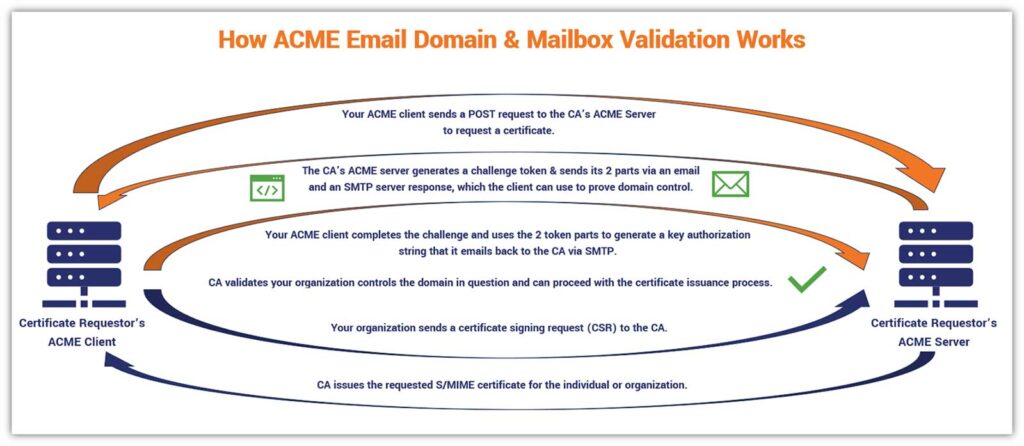
To help facilitate this new method of validation, section 3.2.2.4 also states that CAs may use ACME External Account Binding (a la RFC 8555) to associate a certificate requestor’s ACME account with other information the CA may have validated (such as organization subject details).
What’s the Benefit?
If you’re curious why all of this matters, we reached out to Stephen Davidson, Senior Manager in Global Governance, Risk & Compliance at DigiCert. Davidson is chair of the CABF S/MIME Certificate Working Group, so we asked him to share his insights:
“Historically, S/MIME CAs have relied upon the ‘domain control’ methods that are defined in the TLS Baseline Requirements. However, the trend has been to deprecate some of these methods and to emphasize others, like ACME, that are very specific to TLS/website certificates. The S/MIME Certificate Working Group wishes to encourage the development of automation options that are specific to the needs of S/MIME, of which this method is a good example.”
As an added bonus, client software with support for the ACME protocol can be used for both proving mailbox control and/or key management.
Now that we know what’s happening in the world of ACME automation, it’s time to shift gears and explore the cryptographic changes that are coming to S/MIME.
SMC013: The Inclusion of PQC Algorithms for S/MIME Certificates
Simply put, PQC is an area that garners significant interest. Why? Because it’s just a matter of time before a cryptographically relevant quantum computer (CRQC) eventually makes its debut.
SMC013 is one of the first standards that defines the use of quantum-resistant cryptography in publicly trusted digital certificates. In this ballot, the S/MIME Certificate Working Group voted to approve the inclusion of two of the quantum-resistant cryptographic schemes that NIST approved last year in the S/MIME Baseline Requirements:
- Module Lattice-Based Digital Signature Algorithm (ML-DSA), which is a type of quantum-resistant cryptographic scheme (based on CRYSTALS-DILITHIUM) that’s used to generate and verify digital signatures.
- Module Lattice-Based Key Encapsulation Mechanism (ML-KEM), which is a key encapsulation mechanism that’s used to establish a quantum computing-resistant shared secret key in public channels for encryption and authentication.
At a more technical level, the updates to the BRs provide parameter specifications regarding ML-DSA and ML-KEM (think of key pair sizes, algorithm identifiers, etc.).
What’s Different: These Certificates Will Use Only PQC Algorithms
Ballot SMC013 defines the use of “single-key” PQC S/MIME certificates that do not rely upon pre-quantum algorithms as a first step.
Why? To give industry participants (namely, CAs) a way to test and experiment with “pure” PQC certificates (i.e., non-hybrid or composite certificates). The goal here is to enable industry leaders to find the best alternatives for the RSA- and ECC-based schemes that can ultimately be broken by CRQCs.
Where S/MIME Is Set to Go from Here
This ballot represents just one of the SMCWG’s first steps toward public trust PQC certificates. “PQC is a totally new category and there is much rule-making still to be done,” said Davidson. “This SMC013 is a preliminary piece of the puzzle.”
Ultimately, the proposed changes to the S/MIME baseline requirements update leave the door open to the inclusion of other types of hybrid and composite S/MIME certificates in the future. Currently, DigiCert offers hybrid PKI certificates, but those are for internal (private PKI) uses only and are not chained to public trust hierarchies.
“We anticipate additional ballots in the SMCWG as work on the underlying IETF RFCs for hybrid certificates and other formats concludes,” said Davidson,
The ballot’s 30-day review period, which began July 21, 2025, gives Working Group members a chance to give the content a final look over. After that, the changes will roll out in version 1.0.11 of the S/MIME Baseline Requirements.
What’s Next on the Agenda
Other topics being considered by the SMCWG include:
- tightening the rules relating to DNS security (DNSSEC) when validating domains and CAA records, in line with changes recently adopted for TLS,
- exploring ways to enable the use of electronic identity (eID) and mobile driver’s licenses in personal validation, and
- determining better ways to present pseudonyms and “role” names such as “Help Desk” in certificates.



5 Ways to Determine if a Website is Fake, Fraudulent, or a Scam – 2018
in Hashing Out Cyber SecurityHow to Fix ‘ERR_SSL_PROTOCOL_ERROR’ on Google Chrome
in Everything EncryptionRe-Hashed: How to Fix SSL Connection Errors on Android Phones
in Everything EncryptionCloud Security: 5 Serious Emerging Cloud Computing Threats to Avoid
in ssl certificatesThis is what happens when your SSL certificate expires
in Everything EncryptionRe-Hashed: Troubleshoot Firefox’s “Performing TLS Handshake” Message
in Hashing Out Cyber SecurityReport it Right: AMCA got hacked – Not Quest and LabCorp
in Hashing Out Cyber SecurityRe-Hashed: How to clear HSTS settings in Chrome and Firefox
in Everything EncryptionRe-Hashed: The Difference Between SHA-1, SHA-2 and SHA-256 Hash Algorithms
in Everything EncryptionThe Difference Between Root Certificates and Intermediate Certificates
in Everything EncryptionThe difference between Encryption, Hashing and Salting
in Everything EncryptionRe-Hashed: How To Disable Firefox Insecure Password Warnings
in Hashing Out Cyber SecurityCipher Suites: Ciphers, Algorithms and Negotiating Security Settings
in Everything EncryptionThe Ultimate Hacker Movies List for December 2020
in Hashing Out Cyber Security Monthly DigestAnatomy of a Scam: Work from home for Amazon
in Hashing Out Cyber SecurityThe Top 9 Cyber Security Threats That Will Ruin Your Day
in Hashing Out Cyber SecurityHow strong is 256-bit Encryption?
in Everything EncryptionRe-Hashed: How to Trust Manually Installed Root Certificates in iOS 10.3
in Everything EncryptionHow to View SSL Certificate Details in Chrome 56
in Industry LowdownA Call To Let’s Encrypt: Stop Issuing “PayPal” Certificates
in Industry Lowdown